
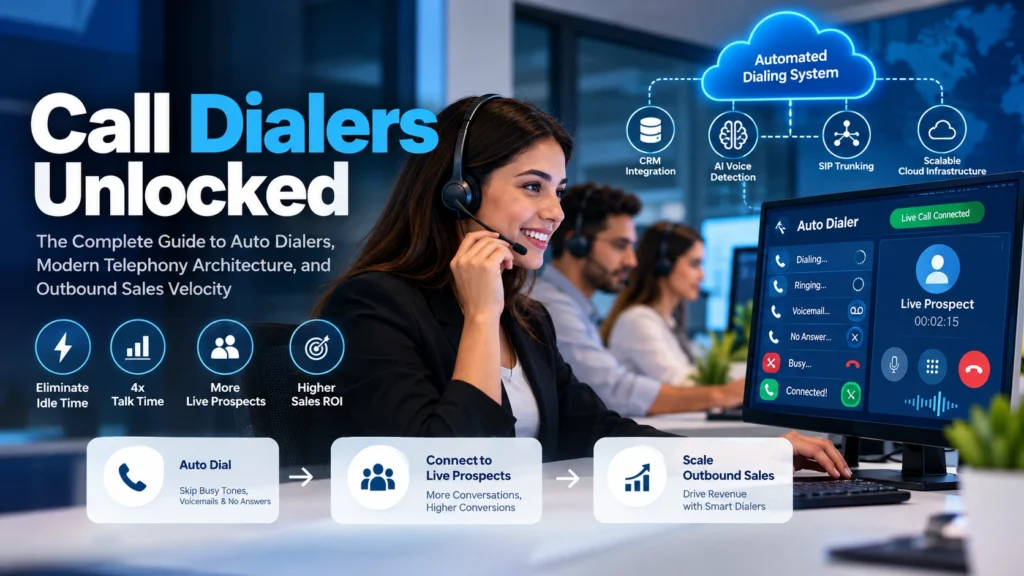
In modern outbound sales, manual dialing is an operational bottleneck.
When sales development representatives (SDRs) or floor agents spend their shifts manually typing numbers on a desktop keypad, listening to dial tones, and leaving voicemails, their actual conversation time drops to less than 15 minutes per hour. The remainder of the workday is consumed by non-revenue activity.
Deploying high-performance call dialers transforms this dynamic.
A modern automated dialing system bypasses unproductive signals such as busy tones, disconnected routes, answering machines, and unanswered rings to bridge sales agents exclusively to live, receptive human prospects.
Whether your goal is to equip a 10-seat outbound team with an agile cold calling dialer or deploy a high-concurrency auto dialer call center floor across hundreds of seats, choosing the right dialer software dictates your unit economics, lead burn rate, and caller ID reputation.
This guide provides an architectural breakdown of enterprise sales dialers, explains the mechanics of modern phone dialer system deployments, and outlines how to scale outbound revenue using cloud-native WebRTC.

1. What Are Call Dialers?
A phone dialer system is a software application or telephony gateway that automates outbound call placement to a contact database.
The technology has evolved through three distinct generations.
Generation 1: Physical PBX & Copper Lines
- Mechanical deskphones
- Manual number entry
- Rigid PRI cards
- Physical telephony infrastructure
Generation 2: On-Premise Dialer Programs
- Asterisk/VICIdial servers
- Desktop softphones such as ZoiPer
- Local infrastructure
- Higher latency and maintenance requirements
Generation 3: Browser-Native Cloud Dialers
- Elastic WebRTC
- Sub-100ms audio bridging
- AI-driven Answering Machine Detection (AMD)
- REST APIs
- Browser-based agent experience
Early systems, often referred to as standalone dialer programs, required on-premise PBX servers, physical PRI line cards, and locally installed phone dialler software such as ZoiPer, eyeBeam, or MicroSIP on every agent workstation.
These systems could experience internal bridging delays, network jitter, and cumbersome manual list loading.
Modern cloud-native call center dialer software operates within web browsers using WebRTC (Web Real-Time Communication).
Key capabilities include:
- Sub-100ms Audio Bridging: Reduces post-connect dead air when a prospect answers.
- Elastic Concurrency: Enables scaling from small teams to large outbound operations without local hardware upgrades.
- Unified Pipeline Orchestration: Integrates with CRM systems to update lead stages, capture recordings, and trigger automated follow-ups.
2. Understanding the Auto Dialer Spectrum
Not all sales dialers operate using the same dialing logic.
Deploying an aggressive pacing engine on a high-value enterprise list can create unnecessary pressure on valuable relationships, while using a conservative dialer on cold consumer data can increase customer acquisition costs.
Auto Dialer Comparison
| Dialer Mode | Dialing Ratio | Primary Use Case |
| Predictive Dialer | Multi-Line, 2:1 to 5:1 per agent | Cold list telemarketing, credit cards, debt collections, high-volume BPOs |
| Progressive / Power Auto Dialer | Strict 1:1 | Warm inbound leads, real estate inquiries, insurance quotes, scheduled callbacks |
| Preview Dialer | Controlled 1:1 | High-ticket B2B enterprise sales, wealth management, VIP corporate accounts |
| Smart Inbound / Blended Engine | Dynamic Queue Balancing | Combined customer support and outbound customer retention operations |
2.1 Predictive Auto Dialer
A predictive auto dialer uses statistical algorithms such as Erlang-B and Erlang-C models to forecast agent availability.
It calculates factors such as:
- Average talk time
- Wrap-up time
- Line connection rates
- Agent availability
The system can then dial multiple phone numbers simultaneously before agents finish their active conversations.
Advantage
Maximizes agent utilization and can increase active talk time to approximately 45–50 minutes per hour.
Tradeoff
Predictive dialing requires a sufficient number of active agents, typically 15+, for the pacing algorithm to maintain a low abandonment rate.
2.2 Progressive & Power Sales Dialers
A progressive automated dialing system operates on a strict 1:1 dialing ratio.
Once an agent completes their active call disposition, the system launches the next call.
Advantages
- Reduces abandoned calls
- Reduces silent calls
- Keeps an agent available before the next call is initiated
Best Fit
Progressive dialing is suited to high-intent marketing leads, including:
- Website demo requests
- Paid Meta submissions
- Google Ads leads
- Scheduled callbacks
2.3 Preview Dialer
A preview dialer retrieves contact history, previous call notes, and company information from the CRM.
The agent receives the complete customer profile before initiating the call.
Advantages
- Supports personalized outreach
- Gives agents relevant customer context
- Supports research-driven sales conversations
Best Fit
Preview dialing is particularly suited to high-ticket B2B account-based marketing where contact quality is more important than raw call volume.
3. Selecting a Cold Calling Dialer
Outbound SDR teams face distinct operational challenges.
When selecting a dedicated dialer for cold calling, the focus shifts from basic call delivery to:
- Protecting caller identity
- Maximizing speed-to-connect
- Managing outbound calling volume
- Reducing unnecessary agent wait time
A modern cold calling dialer must address two core operational obstacles.
3.1 Caller ID and Spam Tagging
If representatives place hundreds of outbound calls from a static phone number, telecom carriers and spam-filtering applications can flag the caller ID.
Once marked as spam, answer rates can decline.
Solution
Enterprise dialers can use Dynamic Number Pools to rotate authenticated DIDs and manage daily number utilization.
They can also use Local Presence Matching to match caller ID area codes with the prospect’s location.
3.2 The “Hello?” Silence Problem
Legacy detection algorithms can create a delay between a prospect answering and the agent being connected.
This can cause prospects to disconnect before the agent is bridged.
Solution
Advanced dialer software can incorporate Answering Machine Detection (AMD) that analyzes voice characteristics and determines whether the call has reached a person or answering machine.
The system can then automatically disconnect or leave a pre-recorded voicemail without unnecessarily consuming agent time.
4. How an Automated Dialing System Works
To understand how high-volume call dialers maintain performance under heavy loads, it helps to examine the underlying telephony workflow.
4.1 Core Telephony Architecture
1. Agent WebRTC Portal
The agent interface communicates through secure WebSockets (WSS) and Opus HD audio with the cloud PBX core.
2. AI Telephony Logic Engine
The logic layer manages functions such as:
- Answering Machine Detection
- Dynamic pacing
- Caller ID rotation
3. Carrier Interconnect Layer
Outbound calls are transmitted through SIP trunking infrastructure to support low Post-Dial Delay (PDD).
4. CRM Event Bus
Call outcomes, recordings, and lead disposition fields are synchronized with the primary CRM database.
5. The Mathematics of Predictive Pacing
Predictive dialer algorithms dynamically calculate the number of outbound lines to launch using an operational pacing formula:
Pacing Ratio = N_agents × (1 − U_idle) / [C_connect × (1 − D_max)]
Where:
- N_agents: Active agents currently logged into the campaign queue
- U_idle: Target agent idle factor, such as 0.05 for 5%
- C_connect: Real-time answer rate across active data lists
- D_max: Maximum permitted abandonment factor
By recalculating the ratio after completed calls, an enterprise auto dialer call center engine can adjust dialing activity according to agent availability and connection rates.
6. What to Look for in Dialer Software
Evaluating a dialer program requires looking beyond the user interface and reviewing the underlying infrastructure.
6.1 Browser-Native WebRTC
A browser-native WebRTC system can eliminate the need for traditional desktop software installations and unmanaged local SIP ports.
Agents can operate through encrypted HTTPS and WebSocket connections.
6.2 Direct Telecom Routes
Telephony should use carrier-grade SIP trunking infrastructure to support low Post-Dial Delay (PDD) and reliable voice paths.
6.3 Speed-to-Lead Webhooks
API endpoints should be capable of capturing leads from:
- Meta Ads
- Google Ads
- Website forms
These leads can then be injected into an active dialing queue within seconds.
6.4 Scalable Licensing
Organizations should consider platforms that avoid restrictive per-seat licensing models and provide CRM integrations without excessive scaling costs.
6.5 AI-Assisted Hybrid Capabilities
Modern platforms can integrate conversational AI voice bots for:
- Off-hours qualification
- Bulk survey campaigns
- Tier-1 inbound routing
7. Manual Calling vs. Modern Sales Dialers
The operational impact of moving from manual prospecting to automated sales dialers can be measured through several production metrics.
| Operational Metric | Manual Dialing | Standard Desktop Auto Dialer | Syntrivo WebRTC Cloud Dialer |
| Dials Per Agent / Day | 60–80 | 180–250 | 400–600+ |
| Talk Time Per Hour | 12–15 mins | 28–35 mins | 45–52 mins |
| Connection Latency | N/A | 1,200–2,500ms | <100ms |
| AMD Precision | Manual verification | 75% | 98%+ |
| Agent Desktop Footprint | Deskphone / Manual | Desktop softphones | Browser-Native WebRTC |
| Lead Burn Rate | High | High | Ultra-Low |
8. Syntrivo Outbound Calling Infrastructure
Relying on outdated desktop dialers or manual calling routines can restrict sales operations.
Syntrivo Innovations provides cloud communications infrastructure designed for high-concurrency outbound operations.
Cloud BPO Predictive Dialer
A WebRTC browser-based dialing engine designed for high-volume outbound calling with integrated AI voice detection.
Carrier-Grade SIP Trunking
Direct carrier interconnects designed to support high Calls Per Second (CPS) throughput and CLI transmission.
Custom Contact Center CRM
Sales-focused CRM infrastructure supporting lead pipelines, dynamic lead distribution, and contact center workflows.
Conversational AI Voice Bots
Autonomous voice agents designed to conduct outbound qualification calls at scale.

9. Upgrade Your Outbound Calling Infrastructure
Modern call dialers can help outbound teams reduce manual dialing, improve agent utilization, and manage large calling operations through cloud-based infrastructure.
For organizations evaluating automated dialing systems, the right solution depends on factors such as:
- Team size
- Lead volume
- Calling model
- Compliance requirements
- CRM integration
- Required dialing speed
- Inbound and outbound workflow requirements
Request a Platform Architecture Demo
Explore Syntrivo’s outbound calling and enterprise communications solutions to evaluate the appropriate infrastructure for your sales operation.